Showing posts sorted by relevance for query retrograde. Sort by date Show all posts

Wednesday, November 7, 2007

Haute Steampunk! Attack of the Horological Machine No.2

An exciting evening out on the town for the reclusive Watchismo Times! I had the honor of meeting Maximilian Büsser and his new child, the Horological Machine No.2! And for some strange reason, Max trusted me enough to hold his bolted baby even though I almost dropped it into the Bolognese sauce...

Personally, I think he just pulled it out of an antique alien submarine control panel and put a strap on it.

After decades learning and conforming to the rules of corporate watchmaking, Maximilian Büsser broke the chains and started a rebellion - a rebellion called MB&F.

MB&F is an artistic and micro-engineering concept laboratory in which changing collectives of independent horological professionals are assembled each year to design and craft radical Horological Machines.

The ramifications of these audacious projects are profound. By respecting tradition without being shackled by it, MB&F acts as a catalyst in fusing traditional high-quality watchmaking with cutting-edge technology and avant-garde three-dimensional kinetic sculpture.

MB&F's first timepiece, Horological Machine No.1, wrote the first chapter in the story of the revolution, Horological Machine No.2 continues the adventure.

Each of HM2's twin portholes allows the viewer a different perspective of time. On the right, the Jumping Hours and Concentric Retrograde Minutes reveals time up close and 'now', while the Retrograde Date and Bi-Hemisphere Moon Phase on the left dial allows the viewer to take a step back from immediacy and relax.

Horological Machine No.2 (HM2) is a holistically conceived and engineered three-dimensional timekeeping machine for the wrist. The functions and indications were specifically conceived to tailor to the strengths of HM2's chief watchmaker, Jean-Marc Wiederrecht. The bespoke architecture of the highly technical movement was developed to both fit and complement the radical form of the modular case. HM2 is the world's first mechanical movement offering: Instantaneous Jump Hour, Concentric Retrograde Minutes, Retrograde Date, Bi-Hemisphere Moon Phase and Automatic Winding.

With over 450 components making up its case and movement HM2 is an incredible sophisticated machine; however, its complexity has been engineered for simple and trouble free functionality.

The movement features an extremely energy efficient Jump Hour/Retrograde mechanism developed by Jean-Marc Wiederrecht. Wiederrecht's exclusive (and patented) asymmetrical-tooth gear wheels ensure high precision and play-free functionality.

The realisation of HM2’s complex case shape - with its architectural volume, bold flying buttresses, bolted portholes and sliding crown guard - was only made possible by using an innovative modular approach: a method inspired by the Meccano sets (similar to Erector sets) of Maximilian Büsser's childhood.

Horological Machine No.2 is full of dynamic tension between apparently incongruous elements. Tension between cutting-edge technology and sculptural art, matte textures and mirror-polishes, high-tech alloys and precious metals and tension between traditional watchmaking and 21st century micro-engineering. This vibrant tension is amplified by the interplay of light and colour off the varied finishes, textures and shapes, and gives the machine its pulsing vitality.

Inspiration and Realization: MB&F is first and foremost about people and the key person behind Horological Machine No.2 is Jean-Marc Wiederrecht. It was 9 years ago, in Maximilian Büsser's former position as Managing Director of Harry Winston Timepieces, that Büsser first began working with Wiederrecht and found him to be imaginative, inventive and sharing in the same human values. Wiederrecht and his company Agenhor are world leaders in Retrograde and Jumping Hour mechanisms and Büsser conceived HM2's functions specifically to play to these strengths.

The case, with its flying buttresses, bolted portholes and sliding crown guard, was so complex - over 100 components go into its construction alone - that it could only be developed with an innovative modular method inspired by the Meccano sets of Maximilian Büsser's childhood. And in line with best engineering principles, this modularity also simplifies future refurbishment of the case should it ever be necessary.

Architecture: The principal feature of Horological Machine No.2 is the holistic symbiosis between the three dimensional architecture of both the case and the movement. The sheer complexity of the case design necessitated a modular approach to construction. More than 100 components go into the assembly of the case alone - that is more parts than make up many complete movements! While extremely complex to fabricate, this bolted-not-welded engineering allows maximum flexibility in design and enables a rich variety of materials and finishes to be used.

Technical Innovations: The principle technical challenge in developing the movement was ensuring that the jumping hour functioned both instantaneously and simultaneously when the retrograde minute flies back from 60 to 0. And not only instantaneously, but also without using excessive energy. The usual method of activating Jumping Hour indications is to store energy in the minutes before the change to power the jump; however, while this energy is being accumulated it takes power from the balance causing it to loose amplitude - an effect detrimental to time-keeping precision. Wiederrecht's solution was as brilliant as it was simple: he designed a ingenious mechanism so that when the minutes fly back, a snail on the minute mechanism hits the hour star causing the hour to jump. The hour jumps instantaneously with the minutes because it is triggered by the minutes and, as the jump is powered by the energy of the minutes flying back, it has virtually no effect on the amplitude of the balance.

The complication has another very special feature. Specific gears in HM2's movement are manufactured to extremely high precision using Mimotec's UV-LIGA technology. These gears mesh together with a virtually a no-tolerance/no-play engagement. Normally, gears interacting this tightly would bind; however, Wiederrecht's patented asymmetrical-split-tooth gear design ensures this does not occur. The high precision of this gearing enables very accurate time-setting and offers high reliability.

To maximise the efficiency of MB&F's already iconic double Hakken automatic rotor, one of the 22kt gold blades was machined down to a razor sharp edge of just 0.2mm - a dimension which pushed the very limits of micro-machining.

The innovative sliding crown guard clearly indicates its position (in or out) and facilitates access to time-setting and quick date correcting.

And now for some candid shots of the new brood. (photographed by and courtesy of Felipe Jordão, the independent horology moderator at Timezone.com - all his photos can be seen here-->Link

The MB&F Clan (HM1 & HM2)


What watch do I wear to such an event?
Well, my cuffbusting vintage Desotos

Max, Watchismo, and the HM2

Priced at $59,000 (US) and in larger editions than the $150,000 HM1.

MB&F website-->LINK

All MB&F related posts-->LINK

Want more? Jack Forster's HM2 article for Horomundi-->LINK


| Watchismo Blog | Watchismo Shop | Contact Us | Subscribe |


Subscribe to The Watchismo Times
Enter your email

Delivered by FeedBurner

Tuesday, October 16, 2007

Vintage Watching - LIP Sector Retrograde, Unusual Heuer, and a Sandoz Mystery Dial

Click to view LIP Retrograde auction

This week on Vintage Watching, I'm featuring one of my favorite watches, the 1973 LIP sector retrograde. They came in a few styles and rarely found for sale. The one above features double retrograde hands (they fly back to the left instantly when reaching the far right) showing hours on bottom and minutes on top.

Click to view the Heuer Auction

Just when I think I've seen every oddball Heuer chronograph of the sixties & seventies, I stumble upon another like the one above. Featuring a very unusual off center 60 minute register. (Update - This might be a fake according to vintage Heuer expert Jeff of OnTheDash.com) Oh well...


Click to view Sandoz Mystery Dial auction

I've seen a few interesting vintage mystery dials from Sandoz, but this unusual 70's "Duplex" above features double-sided hour and minute hands that alternate in length and color when rotating into the visible top portion of the dial. Paul Smith also created a contemporary watch with this style of display->link. Day and month are displayed vertically in the lower obscured hemisphere. Supercool!

Related Posts;
Retrograde Watches
Mystery Dials
Vintage Heuer


Enter The Watchismo Times 1st anniversary vintage chronograph giveway!-->LINK


| Watchismo Blog | Watchismo Shop | Contact Us | Subscribe |


Subscribe to The Watchismo Times
Enter your email

Delivered by FeedBurner

Thursday, March 6, 2008

Rare Recovered Retrograde Wristwatches - Two 1972 Wittnauer Sector Futurama 1000

There were very few double-retrograde watches made in the early seventies but here are two of the very best. The vintage automatic winding "Futurama 1000" by Wittnauer featured only two styles, silver dial and black dial with hours and minutes displayed in an arc (hours on left, minutes on right). As each hand travels to the bottom, they fly-back to the top rather than circularly rotate. These two are particularly fine examples each with their original bracelets. Deep-set magnified portholes for date display.

Black dial (shown above displaying 11:10)-->Link
Silver dial (shown below displaying 11:12)-->Link


Related Posts;
1900 Steampunk Retrograde Pocket Watch
Retired Retrogradation
Raunchy Retrograde
Hautlence
Urwerk
All Retrograde Watch Stories


| Watchismo Blog | Watchismo Shop | Contact Us | Subscribe |

Subscribe to The Watchismo Times
Enter your email

Delivered by FeedBurner

Monday, October 2, 2006

Retired Retrogradation - 1970's Retrograde Watches

Wear one of these masterpieces and pray nobody asks the time... Unless you like talking to strangers, you'll be helping them understand what the hell they're looking at. I'll just pull out my cell phone and get the interaction over with.

Kidding aside, these are very easy to gauge the time as well as my favorite style of timekeeping. Retrograde wristwatches - Time is told as a scale typically passing over an arc of numbers. Each hand has it's corresponding hour or minute measurements and once they grow to the highest increment, they spring back to the opposite side to start the next hour or twelve hour period of timing. Circles? We don't need no stinkin circles!

You can see this feature used in some of the most ridiculously high end wristwatches like Jaeger LeCoultre, Breguet, Gerald Genta, and Glashutte. Generally, it's a retrograde subdial, not an entire watch of retrograde movement like I'm featuring.

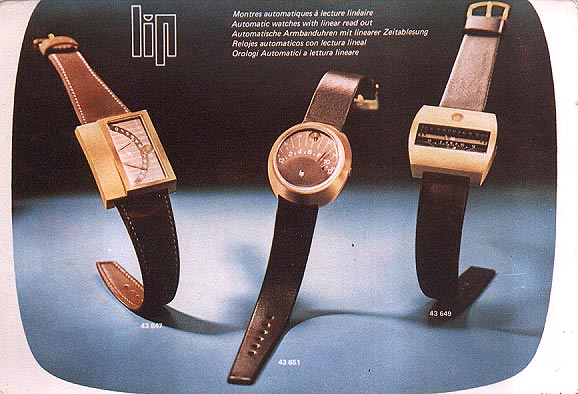
Shown in the photos are the 1970's Sultana, Wittnauer Sector Futurama and the three very rare LIP models. 1 2 3

Apparently, judging from this original LIP advertisement, the LIP Retrograde line were modern dancers when off the wrist...


Thursday, June 7, 2007

Paul Smith Dashboard Watch

Paul Smith has reissued the dashboard style watch, a somewhat tamer variation of the previous model from their fun collection of the late-nineties. Called the PS20, it features what appears to be a retrograde style display (when hands reach the right, they flyback in the blink of an eye), but it's actually just a double handed display. Once one end of a hand is out of view, the opposite end appears. Time is told much like that of many other retrograde watches (seen here-->link) and the casing appears to be brushed steel with a block link bracelet. The date is viewed through a porthole in the bottom half of the watch. £375 (quartz) Paul Smith Watches-->Link

Available in olive, light/dark blue and red

The original model from the late nineties
Polished steel, sport link bracelet, expanding digits

Most of the original collection

Some had mechanical movements, most were Quartz. Many inspirations from the vintage LIP, Christian Dior and Pierre Cardin watches of the seventies. Most of the current collection is pretty drab otherwise.

Related Posts;
Retrograde Lip & Wittnauer Sector Futurama
Other Retrograde Watches


| Watchismo Blog | Watchismo Shop | Contact Us | Subscribe |


Subscribe to The Watchismo Times
Enter your email

Delivered by FeedBurner

Friday, March 13, 2009

New Model - Maîtres du Temps Chapter One Black Dial White Gold Moonphase/Day Roller Tourbillon Watch


Video-->Link

LA CHAUX-DE-FONDS, Switzerland – Building on the launch of the Chapter One in 2008, Maîtres du Temps now presents a limited edition of 11 watches with jet-black dial, moonphase and day of week rollers set in a white gold case.


It explains the development of a $400,000 watch by a team of three master watchmakers: Peter Speake-Marin, Roger Dubuis and Christophe Claret.


Press Release;

Timeless elegance is evoked by the juxtaposition of elegant white gold hands against the black dial and of the bright red of the counterpoised chronograph second hand against the engine-turned sun-ray guilloche of the sub-dials. The ethereal beauty of the moon and stars against a dark night sky belies the high-tech nature of its anodized aluminum roller—a roller visually and technically balanced by the day of the week roller at the opposite end of the long, sweeping compound curves of the stunningly finished case.

The highly polished tourbillon literally explodes from the dark dial in a highly reflective burst of light, some of which streams in through the opening to the day roller and sweeps up from under the tourbillon, adding to the three-dimensionality of the spectacle. Amid the indication-rich nature of the dial, the tourbillon cage and bridge stand out as if under a bright spotlight on a semi-darkened stage.

Moonphase Roller

“To my eye, where the silver-dialed Chapter One leans in the direction of a more classic look, this black-dialed version feels sportier, faster. And I particularly like the way that the black of the dial continues into the dark night sky of the moon roller above and the black day roller below,” says Mr. Steven Holtzman, founder of Maîtres du Temps.


Day of Week Roller

Developed by a collaboration of three of the world’s greatest watchmakers, Mr. Christophe Claret, Mr. Roger Dubuis, and Mr. Peter Speake-Marin, Chapter One features a world-first combination of complications: tourbillon, mono-pusher chronograph, retrograde date, retrograde GMT, and two rolling bars at 6 o’clock and 12 o’clock, indicating the day of the week and phase of the moon, respectively. The dial reveals central coaxial hours, minutes, and chronograph 60-second

counter; tourbillon and day of the week roller at 6 o’clock; retrograde GMT at 9 o’clock; 60-minute chronograph counter and precision moon phase roller at 12 o’clock; and retrograde date at 3 o’clock.

Chapter One is imbued with the intoxicating fusion of Mr. Claret’s undisputed mastery of high-end complications, Mr.Dubuis’ rich lifetime of experience in haute horlogerie, and Mr.Speake-Marin’s unparalleled ability to bridge the very best of both traditional and modern watchmaking.

The ease of both reading and adjusting Chapter One’s many indications disguises the fact that this is an extremely complex movement that has been handcrafted and meticulously assembled from 558 components. Efficiently transmitting power to the two rollers and ensuring that they work simultaneously with the time, date, GMT, and chronograph was just one of the immense technical challenges met and conquered.

About Maîtres du Temps

Maîtres du Temps is a pantheon where teams of independent master watchmakers at the very pinnacle of haute horlogerie collaborate to develop innovative, interesting, and very exclusive timepieces. Founded by Mr. Steven Holtzman and based in Switzerland, Maîtres du Temps crafts limited-series mechanical masterpieces, each the synthesis of the experience, art, and techniques of the Masters who create it. For more information, please visit www.maitresdutemps.com.

Your browser may not support display of this image.

Maîtres du Temps Website

Related Posts;
Independent Watch Brands
Alternative Displays
MB&F HM3
Hysek Colosso

Urwerk
Patek Philippe Cobra Sideview Prototype of 1958
1974 Jaz Derby Swissonic Cylindrical Jump Hour
Jean Dunand Shabaka
Jacob & Co. Quenttin
The Cabestan


| Watchismo Blog | Watchismo Shop | Contact Us | Subscribe |


Wednesday, July 8, 2009

Urwerk King Cobra CC1 Reintrepretation of 1958 Patek Philippe Cobra Prototype - Cylindrical Retrograde Linear Jumping Hour Display

I started this blog nearly three years ago and the watch that started it all was the very obscure 1958 Patek Philippe Cobra -- A timepiece so advanced for its time, only one prototype was ever produced.

It has taken over half a century for someone to take it seriously and attempt a reinterpretation -- Urwerk, the coolest independent brand in the world has just introduced the "King Cobra UR CC1", an unexpected follow-up to their revolutionary Tarantula and Hammerhead series and a serious nod to the masterpiece originally created by Louis Cottier.


Geneva – September 2009

Time is usually - nearly always - displayed by a circular indication: one dial and two (or three) with the time displayed around a perpetual circle. However, this 360° representation of time goes against everything we learnt as we grew up drawing a straight line on a blank page and marking it Past, Present and Future. Why do we think of time as travelling in a straight line yet display it rotating around a circle? The answer is straightforward: mechanisms that continually rotate are much simpler to produce than those that trace a straight line then return to zero. In fact, the latter is so difficult that, until now, nobody has ever managed to develop a production wristwatch with true retrograde linear displays.

Linear. On the UR-CC1, there are two horizontal indications displayed by two retrograde cylinders: one for the (jumping) hours, the other for the minutes. And don't be lulled by the apparent simplicity of the displays; the UR-CC1 is the result of more than three years of research, development, production and testing to ensure that the rotation and instant fly-back of the large hour and minute cylinders was achieved without compromising accurate timekeeping.


Triple-cam. A vertical triple-cam operating a rack (visible through a window in the side of the case) rotates the minute cylinder. From zero to 60 minutes, the minute cylinder rotates through 300°. On arriving at the 60-minute mark the cylinder instantly (1/10th of a second) reverses back to its original position thanks to an extra-flat linear spring. The retrograde movement of the minute cylinder triggers the hour cylinder to advance (jump) one complete hour.

The triple-cam is crafted from bronze beryllium, a metal selected for its inherently self-lubricating properties and low co-efficient of friction, and takes the form of three small inclines. The precise shape of the curve of the incline is relayed to the pivoting rack, while the teeth on the end of the rack mesh with and rotate the minute cylinder. The triple-cam makes a complete rotation in three hours so that each of the three inclines takes 60 minutes, and 180 points of reference have been calculated on each of the three cams to ensure the precise and isochronic rotation of the minute cylinder.

Rack: The toothed segment at the end of the rack transmits and transforms the rotation triple-cam into the rotation of the minute cylinder. The toothed rack presents two properties that at first appear contradictory: absolute rigidity, so as to accurately transmit the motion of the cam to the minute cylinder; and extremely low mass to consume as little energy as possible and minimise the effects of gravity and accelerations/shocks. This vital component has been fabricated in nickel by Mimotec using their photolithography process. The honeycomb pattern of the nickel structure resolves the two apparently contradictory requirements of maximum strength and minimum weight.


Seconds disk: The dial of the UR-CC1 is animated by a rotating disk displaying the seconds both digitally and linearly – a world first! This incredible exploit was achieved thanks to Mimotec’s photolithography production technique, which enabled the component to be fabricated from ultra-light nickel; the procedure is even more precise than electro-erosion. To reduce mass to an absolute minimum, the minuscule numerals were even skeletonised. A small tab at 10 seconds bearing the URWERK logo precisely counterbalances the disk's single-digit numbers. This marvel of micro-precision weighs only 0.09 grams.

Rotor Fly Brake: UR-CC1 features URWERK’s pneumatic shock-absorbing Rotor Fly Brake automatic winding system, which minimizes rotor and mechanism wear and damage from shock and harsh movements. The operation of the Rotor Fly Brake is visible through a window on the side of the case.


Technical Specifications:

Model: UR-CC1

Case: available in either grey gold with titanium case back (limited edition of 25 pieces) or black gold with titanium case back (limited edition of 25 pieces); brushed-satin finish

Movement: calibre UR-CC1; automatic winding regulated by “fly brake turbine” pneumatic shock absorber

Indications: linear display for hours and minutes with jumping hours and retrograde minutes ; second display both digital and linear

Dimensions: 45.7mm x 43.5mm x 15mm

Dial and Bridges: ARCAP P40. SuperLumiNova treatment on hours, minutes displays

Genesis of a creation

1958. Messrs Gilbert Albert and Louis Cottier combine their talents to create a watch destined to revolutionize the horological world. Their idea is completely outrageous: it is the world’s first watch to feature a linear display. It is an extraordinary, avant-garde piece that fulfils none of the aesthetic criteria of the time. As for its linear indication, the idea may seem simple but the execution is a technical headache of monumental proportions. However Messrs Albert and Cottier believe in it and they stick with it, creating a prototype for Patek Philippe.

Your browser may not support display of this image. 1959. A patent is deposited by Louis Cottier, detailing the technical scale of the achievement. Then – nothing. The prototype is put on to one side. Does the watch even work? Today nobody knows for sure. It took its place in the corner of the Patek Philippe museum and proceeded to arouse curiosity from time to time.

1998. With pencil and paper Martin Frei, co-founder of the URWERK brand and an aesthete at heart, sketches the first outline of his future creation: a watch in which the hours and minutes are indicated by two straight, parallel lines. But he hesitates. With Felix Baumgartner, master watch-maker and co-founder of URWERK, another idea springs to mind – the concept of the hour satellite, presented for the first time at Basel. The earlier project is postponed, sine die.

Your browser may not support display of this image. 2006. URWERK is henceforth known and recognized for its mechanical hour satellite watches in which orbiting hour satellites indicate the minutes. But the idea of developing a different way of telling the time continues to fascinate Felix Baumgartner. In the end it is the Alfred Hitchcock film “The Birds” that gives him the decisive nudge in the right direction. In one of the most famous scenes from the film, the heroine seeks refuge in an old Dodge. The image lasts only a few seconds but it is crucial – a close-up of the dashboard and its linear speedometer. Yes. That’s it! A continuous line with which to mark time. Felix and Martin work non-stop on this new project. Their research leads them to the discovery of Gilbert Albert and Louis Cottier’s watch. It will be their “muse”.

2009. Three years of research. One year of testing. URWERK’s “King Cobra” is unveiled. ‘CC’ for Cottier Cobra, a homage to the genius of Louis Cottier, inventor and creator. Once more, URWERK redefines our vision of fine watchmaking and pushes back the frontiers of the possible.

The original 1958 Cobra


Original Prototype Movement

Watchmaker Felix Baumgartner

I am not big on nostalgia, but I have always loved the linear speedometers found on old cars. My older brother had a 1960’s Volvo and it was that which gave us the first idea for a horological linear indication. I recently watched the film ‘The Birds’ by Alfred Hitchcock, and in it the heroine took refuge in an old Dodge with a linear speedometer- it is one of my favourite scenes. There are very few wristwatches with linear indications. One of them, if not the first, was ‘The Cobra’, which was developed in the late 1950s by Mr. Louis Cottier. It is sensational! Although it was created over half a century ago, it is still very contemporary. Unfortunately, it only exists as a single prototype and was never put into production. Now, 50 years after he filed his patent (1959), URWERK pays homage to the work of Louis Cottier by creating its own interpretation of the Cobra. -Felix Baumgartner

Designer Martin Frei

I am interested in the perception of time. Physicists tell us that time can be warped or stretched, and our daily experiences are with the circular cycles of the days, seasons and years. But I am also intrigued that time can be ordered, even straitjacketed, to flow in a linear direction - a straight line from the past, through the present, to the future. And, because this can represent an individual’s lifeline, I feel that this linear format can be a very human way to look at time. That plus the fact that I think it looks really cool! -Martin Frei

Additional presentation party photos by Ian Skellern of Horomundi

Urwerk Website Link


Related Posts;
Urwerk Tarantula
Urwerk Hammerhead
Urwerk TiAIN 103.08
Interview with Martin Frei
Urwerk Time Bandit
Urwerk Visit


| Watchismo Blog | Watchismo Shop | Contact Us | Subscribe |